ETG Calculator
This EtG calculator is an online tool that estimates how long ethyl glucuronide (EtG) may stay detectable in a urine test after drinking. It gives you a realistic range based on published research and lab guidance, not a made-up number, and it works right in your browser with no signup. Enter your drinks, timing, and body weight below, click Calculate, and see your estimate in seconds.
Calculator inputs
Results
Test Threshold Results
Modeled decline of urinary EtG over time. The shaded band reflects the published range of individual elimination rates, not measurement error.
What Is EtG?
EtG stands for ethyl glucuronide. It is a by-product your body makes when it breaks down alcohol (ethanol). Most of the alcohol you drink is processed by the liver in the usual way, but a small fraction is turned into EtG instead. Alcohol itself clears from your blood and breath within hours. EtG leaves through urine, and it can still be found a day or more after your last drink.
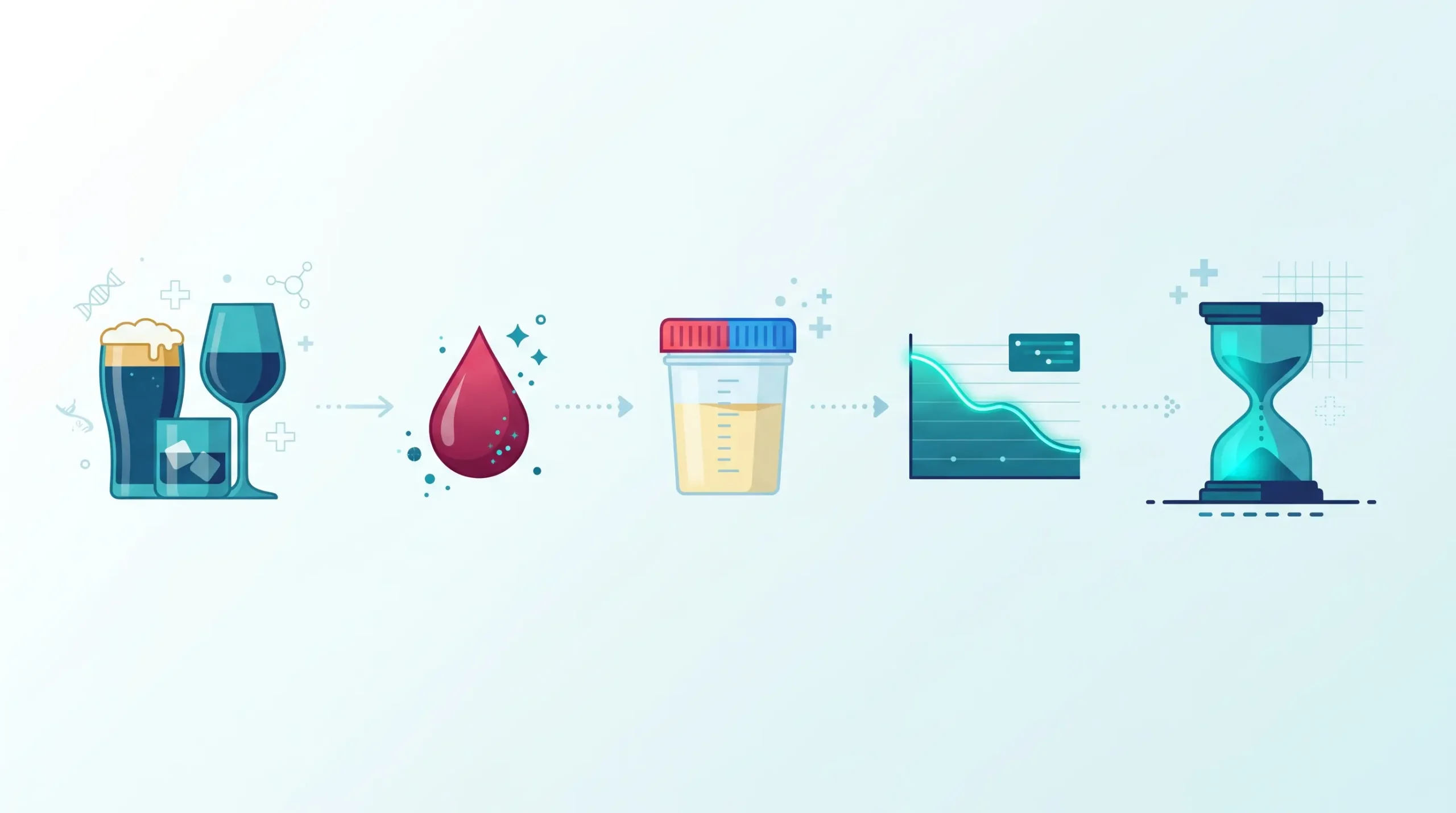
An EtG test measures how much EtG is in a sample, most often urine, and compares it with a cutoff set by the lab. That longer window is why the test exists. A breathalyzer only shows alcohol that is in your body right now, while an EtG urine test can show whether alcohol was in your system over the past day or several days
How This EtG Calculator Works?
EtG is a substance your body makes in small amounts when it breaks down alcohol. It leaves your body through urine, and it sticks around much longer than alcohol itself. That is why an EtG urine test can pick up drinking from the past day or even several days ago, long after a breathalyzer would show nothing.
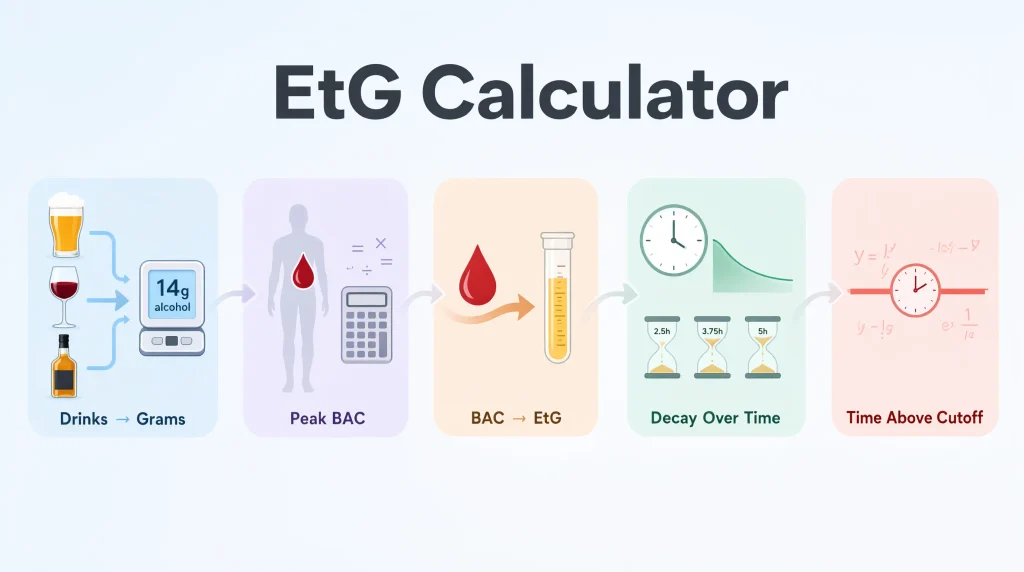
The calculator follows three simple steps:
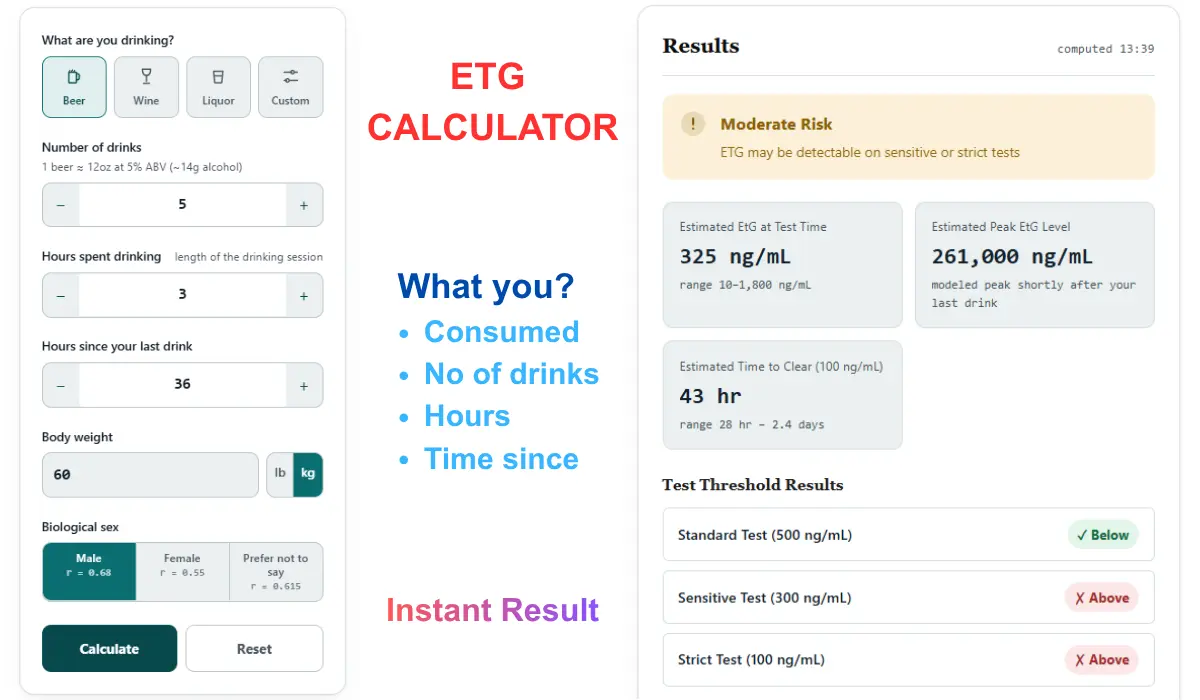
- You enter your details: drink type (beer, wine, liquor, or a custom drink with its volume in ounces and ABV), number of drinks (0 to 30, in half-drink steps), hours spent drinking, hours since your last drink, body weight (in pounds or kilograms), and biological sex.
- A formula does the math: the calculator turns your drinks into grams of alcohol (a standard drink is about 14 grams). It then uses the Widmark formula, which factors in your body weight and sex and subtracts the alcohol your body clears while you drink, to estimate your peak blood alcohol.
That is converted into an estimated peak urine EtG level using a constant calibrated against a published controlled-dosing study. Finally, EtG is allowed to fall over time using half-lives of 2.5 hours (fast metabolizers), 3.75 hours (central estimate), and 5 hours (slow metabolizers). - You get a range, not a single hour: because the fast and slow half-lives give different answers, each result comes with a range, plus a decay chart that plots how your EtG level falls over time.
We show a range on purpose. One exact number would look precise, but it would be pretending to know things about your body that no calculator can know. Want to know in detail? The full formula, assumptions, and detection chart are explained on our ETG methodology explanation.
What Your Result Shows?
After you click Calculate, you will see:
- A quick label: Low (central estimate under 100 ng/mL), Moderate (100 to 499), or High (500 or more), with a one-line explanation.
- Estimated EtG at test time, with the fast-to-slow range underneath.
- Estimated peak EtG level from your drinking session.
- Estimated time to fall below 100 ng/mL, with its range, or a note that your level is already below it.
- Results at three cutoffs: Standard (500 ng/mL), Sensitive (300 ng/mL), and Strict (100 ng/mL), each marked as below or above.
- A decay chart on a log scale, with a shaded band for the fast-to-slow range, dashed lines at the three cutoffs, and a marker for your current time point.
Tips for a More Realistic Estimate
- Count your drinks honestly. Half-drink steps are available.
- For craft beer, strong cocktails, or large pours, choose Custom and enter the real volume in ounces and the ABV.
- Enter the true length of your drinking session and the hours since your last drink, since both change the result.
- Use your actual body weight.
Urine EtG Calculator vs. Alcohol EtG Calculator
People look for this tool in a few different ways: a urine EtG calculator, an EtG urine test calculator, an alcohol EtG calculator, or an EtG alcohol test calculator. They all come down to the same question: if someone drinks, how long could an EtG urine test still detect it?
Our calculator covers both angles in one place.
The Urine Test Side
An EtG test measures how much EtG is in a urine sample and compares it with a cutoff, which is the lowest level the lab counts as positive. Labs use different cutoffs, commonly somewhere between 100 and 1,000 ng/mL. A low cutoff catches smaller amounts and picks up drinking from further back.
A high cutoff only flags more recent or heavier drinking. SAMHSA, the US agency that publishes guidance on this test, describes results as very low positive (100 to 500 ng/mL), low positive (500 to 1,000 ng/mL), and high positive (above 1,000 ng/mL). That is why the calculator shows your result against three common cutoffs at once: 500 ng/mL (standard), 300 ng/mL (sensitive), and 100 ng/mL (strict).
The Alcohol Side
How much you drink, and over how long, changes how much EtG your body produces and how long it takes to clear. More alcohol over a longer stretch generally means a longer detection window. Body weight and biological sex matter too, because they change how alcohol spreads through your body, so the calculator asks for both. If you choose not to say, it uses an average value.
Two things this tool is not. It is built for urine testing, which is the most common type, so it does not cover hair or blood EtG tests. And it does not measure blood alcohol level or impairment, which is a completely different thing from an EtG result.
Is This EtG Calculator Accurate?
Here is the honest answer: it is realistic, but it cannot be exact. If you see a site claiming to be the most accurate EtG calculator with a precise hour-by-hour answer, be careful. Nobody can know exactly how your body will process alcohol or what a specific lab will report.
What Makes This Calculator Realistic
- It gives a range instead of a single time.
- It uses the Widmark formula and a conversion calibrated against a published controlled-dosing study, not guesswork.
- It checks your estimate against three common cutoffs (500, 300, and 100 ng/mL), so you can see how much the cutoff matters.
- It tells you what it cannot account for.
If you are looking for a real EtG calculator rather than a random timer, check for those same things: it should show its assumptions, give a range, and be upfront about its limits. When you compare free tools, the best free EtG calculator is the one that explains how it reached its answer.
What No Calculator Can Know?
- How your own body processes alcohol
- How hydrated you are and how concentrated your urine is
- Exactly how much alcohol was in your drinks, since pours and strengths vary
- Which lab method and cutoff your test actually uses
- Whether you had incidental exposure to alcohol, such as from some hand sanitizers or mouthwashes, which can sometimes cause low-level EtG
General Detection Ranges at a Glance
For a general sense of scale, research and lab guidance report ranges like these for urine tests at common cutoffs:
- Light drinking: often detectable for roughly 12 to 36 hours
- Moderate drinking: often around 1 to 2 days
- Heavy drinking: often 1 to 3 days, and sometimes up to about 5 days
These are general ranges, not promises. Treat your result as a rough guide to help you understand the test. The most accurate answer will always come from the actual test and the lab that runs it.
One more limit worth knowing: the calculator models a single drinking session. If you also drank on earlier days, real EtG levels can stay detectable longer than the estimate shows. Its numbers may also differ from the general ranges above, because it calculates from your specific inputs rather than broad categories.
Frequently Asked Questions
Please Read Before Relying on Your Result
This calculator is an educational tool. Its results are estimates, not medical advice, and not a guarantee of what any test will show. It does not measure alcohol level or impairment, so never use it to decide whether it is safe to drive or operate machinery. It is also not meant to help anyone mislead a testing program, and we do not offer ways to avoid detection. If you are in a monitoring program, follow its rules and ask your provider about your testing. Read our full disclaimer.
If you are worried about your own or someone else’s drinking, the SAMHSA National Helpline in the US is free and open 24 hours a day at 1-800-662-4357.Want to see exactly how the numbers are produced? Read our methodology page for the formula, assumptions, and detection chart behind this calculator